Article taken from Bluegrassové listy 25/4 (Bluegrass Letters) – the quarterly magazine of the Bluegrass Association of the Czech Republic.
In the last issue of Bluegrass Letters, I enjoyed reading the interview with the Turner brothers, who participated in this year’s Steve Kaufman’s Acoustic Kamp*, held in June 2025 in Maryville, Tennessee. I thought that some readers might also be interested in how I, one of the 28 instructors, perceived the Kamp. For a guy who grew up in the 1990s and 2000s listening to Czech and later American bluegrass recordings, this was an exceptional opportunity and something that would have been unimaginable before.
Of course, it didn’t happen overnight. I have been teaching workshops since 2004. At first, these were events organized by Petr Brandejs, and 10 years ago, I started organizing my own workshops, of which I have held more than 40. In addition, I have experience teaching at other international workshops, for example in Spain, Sweden, Germany, Norway, and elsewhere. And because my bandmate Radim Zenkl lived in America for many years and taught at Kamp in the past, Steve invited us both this year to not only teach during “Bluegrass Week” (preceded by “Old-time Week”), but also to play at one of the evening concerts for instructors. These concerts are the highlight of each day at Kamp, with about six instructors performing three songs each, often inviting guests from among their colleagues, and it is always a great experience.

I couldn’t pass up this opportunity. I was quite interested in the musical level of amateur musicians overseas – of course, we mainly hear about the top professionals. From an organizer’s point of view, I was even more interested in how the workshops are run there (although this one is about five times larger than the ones I organize). Registration for the camp opens a year in advance, and many participants take advantage of this. Similar to our camps, many people return primarily because of the group of musicians, and only secondarily because of the music and teaching itself.
Although I am generally more interested in the work than in the personalities of “celebrities,” I was already excited during the presentation of the instructors on the first evening to be standing next to such icons of our genre as Darol Anger, Kenny Smith, Wayne Benson, Greg Cahill, and others. The next evening, Radim and I received a very warm welcome from a packed hall on the same stage, and I had to thank people for their comments on our performance throughout the week.

Upon arrival, each participant receives a thick notebook. This year’s guitar notebook had 136 pages and contained materials from all five instructors (about 15 pages from each). The notebook also contains general instructions and materials, programs, schedules, and, of course, advertisements. At Kamp, all instructors teach all participants who sign up for a given instrument. Guitarists were divided into five groups of about ten members according to their level of advancement, and the instructors rotated between the groups, leading two two-hour lessons for each. This may be a little inconsistent in terms of teaching, but it allows students to experience five different approaches to playing and teaching and get to know all the teachers personally, which is a considerable attraction in the case of big names. It also prevents burnout among students and teachers, as the lessons take place over five days.
I had a good feeling about the guitar lessons, and my initial slight uncertainty (after all, it was my first time) quickly faded. My speeches were probably shorter and simpler than those of my colleagues – native speakers – but we played all the more. I tried to focus a lot on the practical aspects of technique and theory, which, as I understood from the feedback from several participants, was not the approach of all the teachers. Some of them tended to demonstrate things and talk a lot. I was quite surprised that none (!) of the approximately fifty students asked me about rhythm guitar – they were all interested in playing melodies and solos. It is fair to add that there was one class at Kamp dedicated solely to rhythm guitar, but from my perspective as a (co-)player, accompaniment is definitely a more important guitar discipline than playing solos. So when I brought up this topic on the third day and gave it a brief introduction, everyone accepted it very gratefully, and I was confirmed in a common European superstition that “Americans are just born with a good sense of rhythm” is a myth.

In addition to group lessons, the program included a Master Class, which is a special lesson where individuals sign up with a specific instructor, who then spends about five minutes with each of them while the others observe. We have been practicing something similar for several years in my workshops, but these are half-hour individual lessons, which others can also participate in (if the student does not mind, of course). For many participants, these are moments of greatest immersion in the subject matter and big “aha moments.” It was no different at Kamp. Another interesting feature of the program was the so-called Class Scrabble – an hour-long lecture by each lecturer, which anyone could attend. The topics were really diverse: from music theory to guided listening to how to make good coffee on the road.
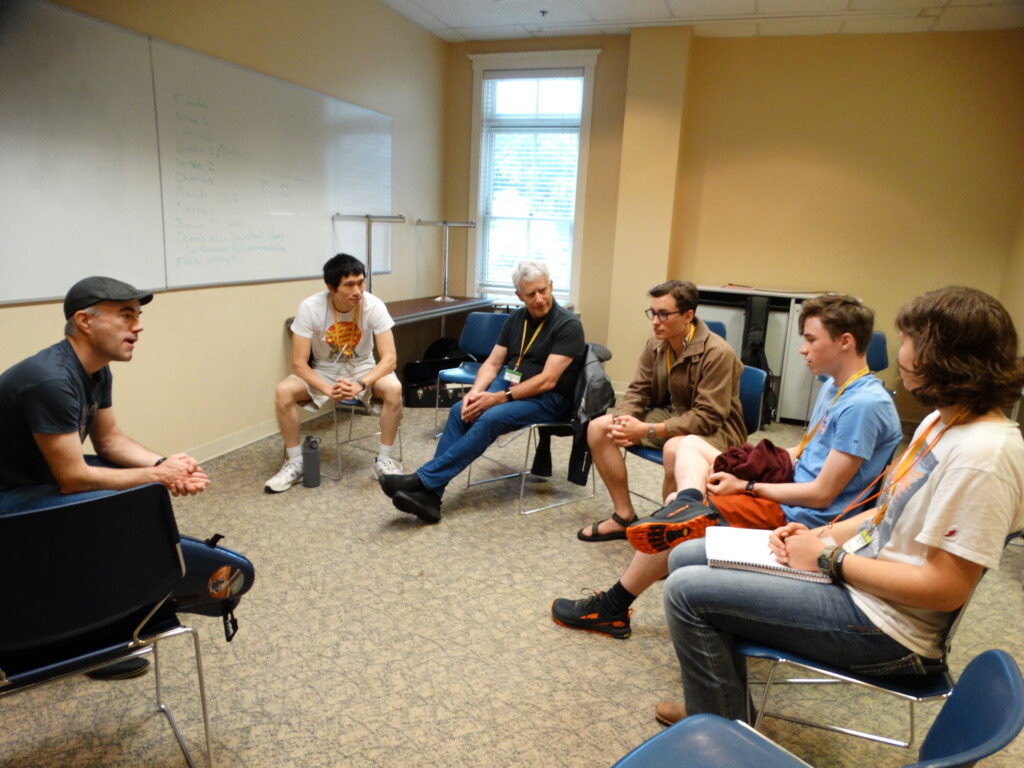
The program included three slow jam sessions a day (!) led by an instructor. Shy and less advanced participants certainly couldn’t complain about a lack of opportunities to play together. There was also time to rehearse with a band made up of participants. They rehearsed for a concert that took place on Friday morning. Here, I noticed a significant difference compared to concerts at my workshops, perhaps due to a different mentality. Americans are simply not afraid to perform in front of others, they are not afraid to make mistakes, and they allow themselves to enjoy it. Although I was a little worried during rehearsals that the fragile arrangements would fall apart on stage due to stage fright, it turned out great and sounded even better on stage than in rehearsal. Playing together with others and informal performances are among the most enjoyable and lasting experiences at our workshops as well. At this year’s Bluegrass Vegas workshop, where I put together bands from participants who may never have met before, one group agreed in euphoria after the final performance that they want to come back next year and play with exactly the same lineup!
An important part of Steve’s workshop is the Kamp Store. It’s a store where you can find instruments and accessories and lots of lessons and recordings by instructors – especially Steve’s. You can get significant loyalty discounts here for attending previous camps. Steve is simply a born businessman, and not just because of his last name 🙂

A big difference from bluegrass events on the old continent was the number of children and teenagers participating in Kamp and their often surprisingly high level of playing. On the last evening, we jammed in a circle with about ten children in the university park, and musically it was a real experience (not to mention the community aspect). In this respect, we are unfortunately far behind in Europe. At last year’s IBMA – World of Bluegrass, I also saw mainly juniors jamming – everywhere, all the time, and with high quality.
However, the strongest impression I took away from Kamp was the openness and positive attitude of the people I met there. Everyone is incredibly friendly, sincere, and not afraid to say positive things out loud that we Czechs often only think. After our concert at the Station Inn in Nashville, which took place the following week and where the Czech junior participants of Kamp played with us, I talked to them briefly about it. They, too, quickly made friends in the States, and I encouraged them to bring this “thing” home with them. If we really need to learn something from Americans, it may not necessarily be music, but this non-judgmental and supportive attitude towards others.
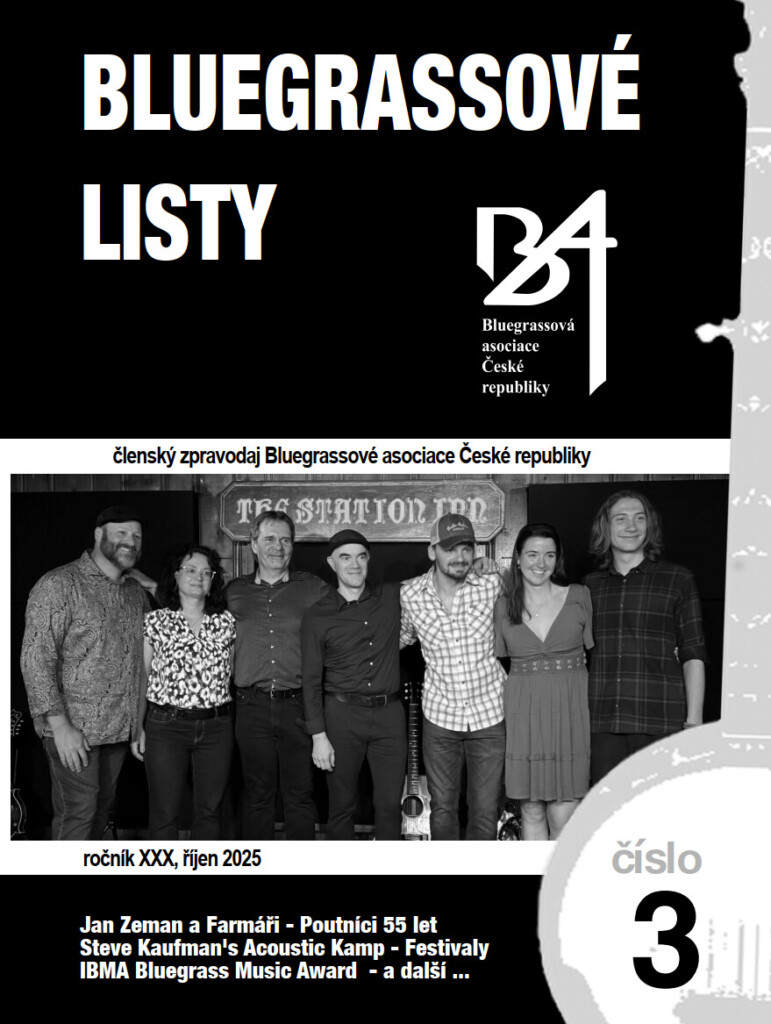
At the end of this report, I would like to thank Petr Brandejs for confidently introducing me to the world of workshops and teaching twenty years ago, thanks to which I can now do what I enjoy and help others. I must also thank my partner Radim Zenkl in particular – not only for making music together in recent years, but also for “nominating” us both for this year’s Kamp and for taking care of my work visa, without which it would not have been possible. You can find more photos from this year’s travels (not only with Radim and not only to the USA) here. And I would like to thank Steve Kaufman for his impeccable organization, for his trust, and for inviting me to the next, 30th edition of Kamp in 2026. If you would like to take a trip to the United States combined with music, I can highly recommend Steve Kaufman’s Acoustic Kamp (information at flatpik.com). If that’s too far for you, I’d be happy to see you at one of the five ATAmusic camps in Zlaté Hory, which is just around the corner. I look forward to seeing you there!
Ondra Kozák


* Note: In America, workshops are often called camps. The term “Kamp” is a funny play on words (probably derived from Steve’s surname) and also a brand name – you will find many words containing the letter C in printed and online materials with the letter K (domain flatpik.com, salutation “Kampers and Kompanions”…).